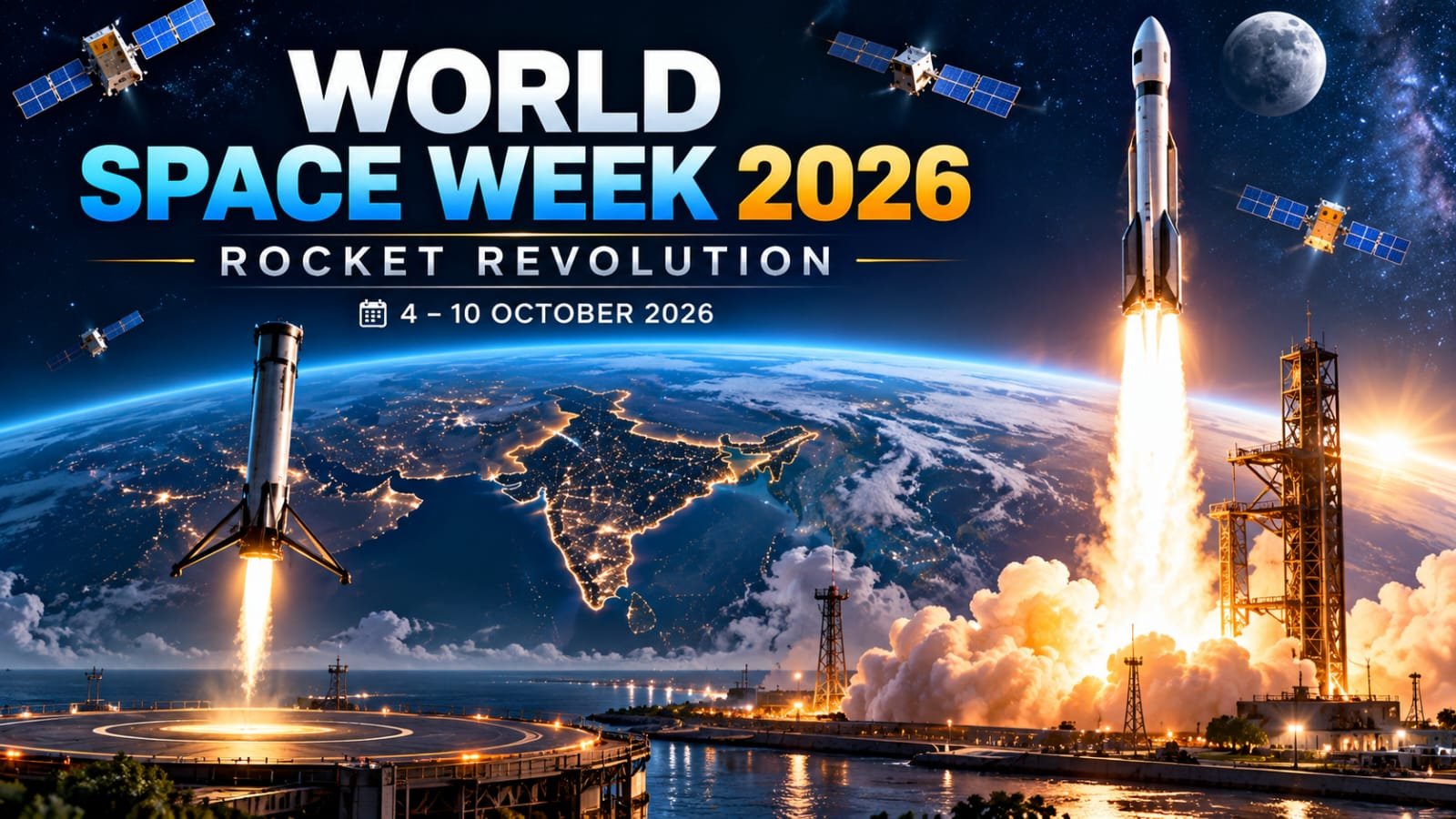

World Space Week 2026 concluded on October 10, highlighting the rapid transformation of space exploration under the theme “Rocket Revolution.” Observed annually from October 4 to 10, the international event promotes awareness of space science, technology and their benefits to society.
The 2026 theme focused on how reusable rockets, commercial launch companies, universities and emerging space startups are making access to space more flexible and potentially less expensive.
Why Is “Rocket Revolution” Important?
For decades, launching satellites and spacecraft required substantial investment, specialised infrastructure and the resources of a limited number of government space programmes. New launch technologies and growing private-sector participation are changing that landscape.
Reusable launch vehicles can potentially reduce the cost of sending payloads into orbit by allowing important rocket components to be recovered and used again. More frequent launches can also help satellite operators deploy new technology and replace older spacecraft more efficiently.
However, reusability does not make every launch inexpensive. Development, refurbishment, fuel, insurance and mission requirements still affect the total cost.
How Is India Contributing to Space Exploration?
India has developed a major space programme through the Indian Space Research Organisation (ISRO), with achievements in satellite communications, Earth observation, navigation and planetary exploration.
India’s commercial space ecosystem is also expanding, with private companies working on launch vehicles, satellite manufacturing and other space technologies. The Indian National Space Promotion and Authorisation Centre (IN-SPACe) supports private-sector participation in the country’s space activities.
These developments could create opportunities for engineering students, researchers, manufacturers and technology businesses.
What Benefits Can Space Technology Bring to Everyday Life?
Space technology is not limited to astronauts and scientific missions. Satellite systems support several services people use regularly.
- Weather forecasting: Satellite observations help track clouds, cyclones and other weather systems.
- Agriculture: Remote sensing can help monitor crops, soil conditions and water resources.
- Navigation: Satellite navigation supports transport, mapping and location-based services.
- Communications: Satellites can connect remote regions where conventional networks are limited.
- Disaster management: Earth-observation data can help authorities assess floods, fires and other emergencies.
These applications demonstrate how investment in space science can provide practical benefits on Earth.
Opportunities for Students and Young Innovators
World Space Week also encourages students to explore science, technology, engineering and mathematics. Young people interested in the sector can begin by learning physics, mathematics, electronics, programming, robotics or satellite-data analysis.
Schools and colleges can organise astronomy sessions, model-rocketry demonstrations, space quizzes and satellite-image projects to introduce students to the field.
Anyone building model rockets should follow local laws, use safe educational kits and avoid homemade propulsion systems or hazardous materials.
The Future of Space Exploration
The next phase of space development will likely involve a combination of government missions, commercial launch providers, international cooperation and academic research.
Reusable rockets and lower launch costs may expand opportunities for satellite services and scientific missions. At the same time, the sector must address challenges such as space debris, orbital congestion, launch safety and the long-term sustainability of space activities.
Conclusion
World Space Week 2026 placed the spotlight on the “Rocket Revolution” and the technologies reshaping access to space. As launch systems evolve and more organisations enter the sector, space technology could play an increasingly important role in communication, environmental monitoring, research and economic development.
The larger message is that space exploration is not only about reaching distant worlds—it is also about developing technologies that can improve life on Earth.
Sources: United Nations — World Space Week; ISRO/Vikram Sarabhai Space Centre — World Space Week 2026.
World Space Week 2026: How the “Rocket Revolution” Is Changing Space Exploration
World Space Week 2026 concluded on October 10, highlighting the rapid transformation of space exploration under the theme “Rocket Revolution.” Observed annually from October 4 to 10, the international event promotes awareness of space science, technology and their benefits to society.
The 2026 theme focused on how reusable rockets, commercial launch companies, universities and emerging space startups are making access to space more flexible and potentially less expensive.
Why Is “Rocket Revolution” Important?
For decades, launching satellites and spacecraft required substantial investment, specialised infrastructure and the resources of a limited number of government space programmes. New launch technologies and growing private-sector participation are changing that landscape.
Reusable launch vehicles can potentially reduce the cost of sending payloads into orbit by allowing important rocket components to be recovered and used again. More frequent launches can also help satellite operators deploy new technology and replace older spacecraft more efficiently.
However, reusability does not make every launch inexpensive. Development, refurbishment, fuel, insurance and mission requirements still affect the total cost.
How Is India Contributing to Space Exploration?
India has developed a major space programme through the Indian Space Research Organisation (ISRO), with achievements in satellite communications, Earth observation, navigation and planetary exploration.
India’s commercial space ecosystem is also expanding, with private companies working on launch vehicles, satellite manufacturing and other space technologies. The Indian National Space Promotion and Authorisation Centre (IN-SPACe) supports private-sector participation in the country’s space activities.
These developments could create opportunities for engineering students, researchers, manufacturers and technology businesses.
What Benefits Can Space Technology Bring to Everyday Life?
Space technology is not limited to astronauts and scientific missions. Satellite systems support several services people use regularly.
- Weather forecasting: Satellite observations help track clouds, cyclones and other weather systems.
- Agriculture: Remote sensing can help monitor crops, soil conditions and water resources.
- Navigation: Satellite navigation supports transport, mapping and location-based services.
- Communications: Satellites can connect remote regions where conventional networks are limited.
- Disaster management: Earth-observation data can help authorities assess floods, fires and other emergencies.
These applications demonstrate how investment in space science can provide practical benefits on Earth.
Opportunities for Students and Young Innovators
World Space Week also encourages students to explore science, technology, engineering and mathematics. Young people interested in the sector can begin by learning physics, mathematics, electronics, programming, robotics or satellite-data analysis.
Schools and colleges can organise astronomy sessions, model-rocketry demonstrations, space quizzes and satellite-image projects to introduce students to the field.
Anyone building model rockets should follow local laws, use safe educational kits and avoid homemade propulsion systems or hazardous materials.
The Future of Space Exploration
The next phase of space development will likely involve a combination of government missions, commercial launch providers, international cooperation and academic research.
Reusable rockets and lower launch costs may expand opportunities for satellite services and scientific missions. At the same time, the sector must address challenges such as space debris, orbital congestion, launch safety and the long-term sustainability of space activities.
Conclusion
World Space Week 2026 placed the spotlight on the “Rocket Revolution” and the technologies reshaping access to space. As launch systems evolve and more organisations enter the sector, space technology could play an increasingly important role in communication, environmental monitoring, research and economic development.
The larger message is that space exploration is not only about reaching distant worlds—it is also about developing technologies that can improve life on Earth.

 By
By